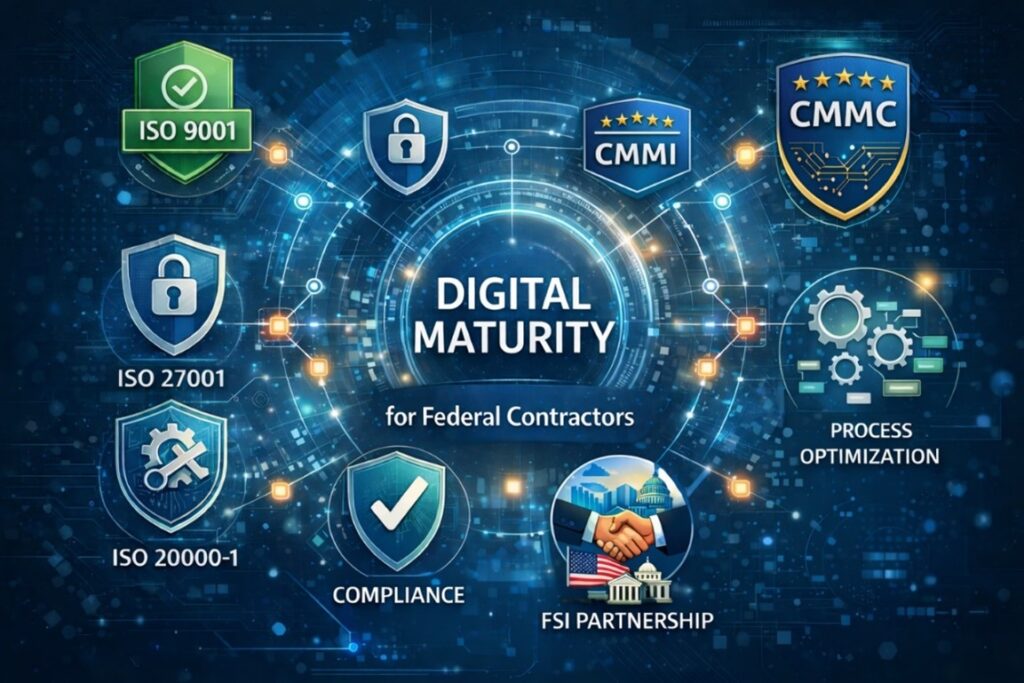
Integration Technologies Group, Inc. (“ITG”) works alongside leadership teams to deliver ISO and Capability Maturity Model Integration (“CMMI”) initiatives aligned with business goals, not just standards or frameworks.
For many executive teams, frameworks like ISO 9001, ISO 27001, ISO 20000-1, and CMMI are often introduced under pressure: customer requirements, regulatory expectations, competitive bids, or growth milestones. While these frameworks are powerful, they are frequently implemented in ways that deliver compliance but fall short of real business impact.
The difference between success and frustration lies not in the frameworks themselves, but in how leadership expects them to be applied.
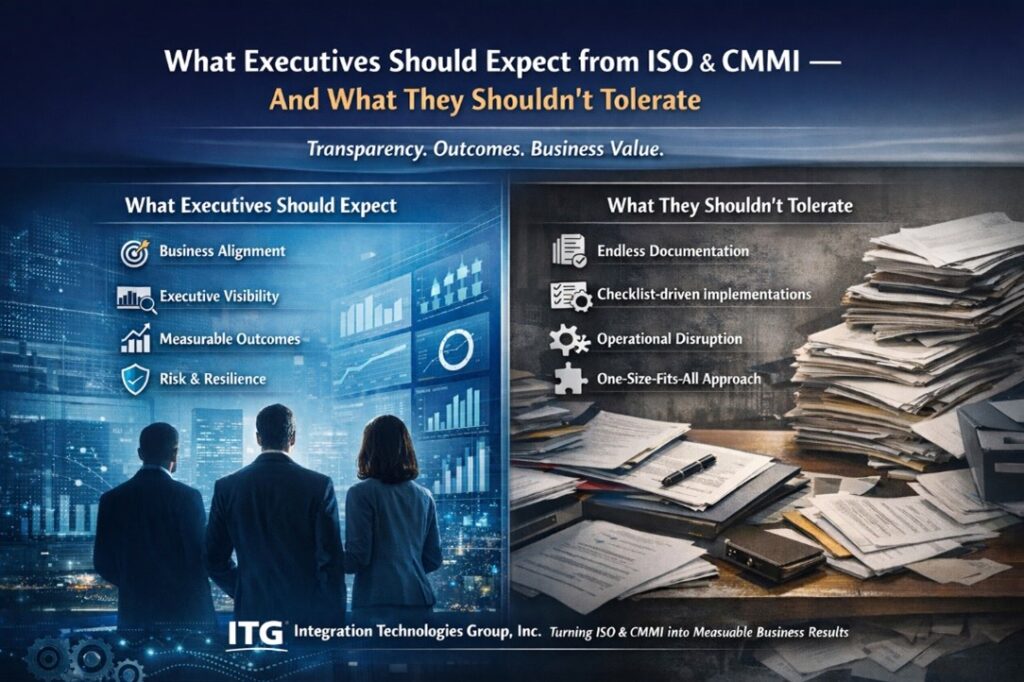
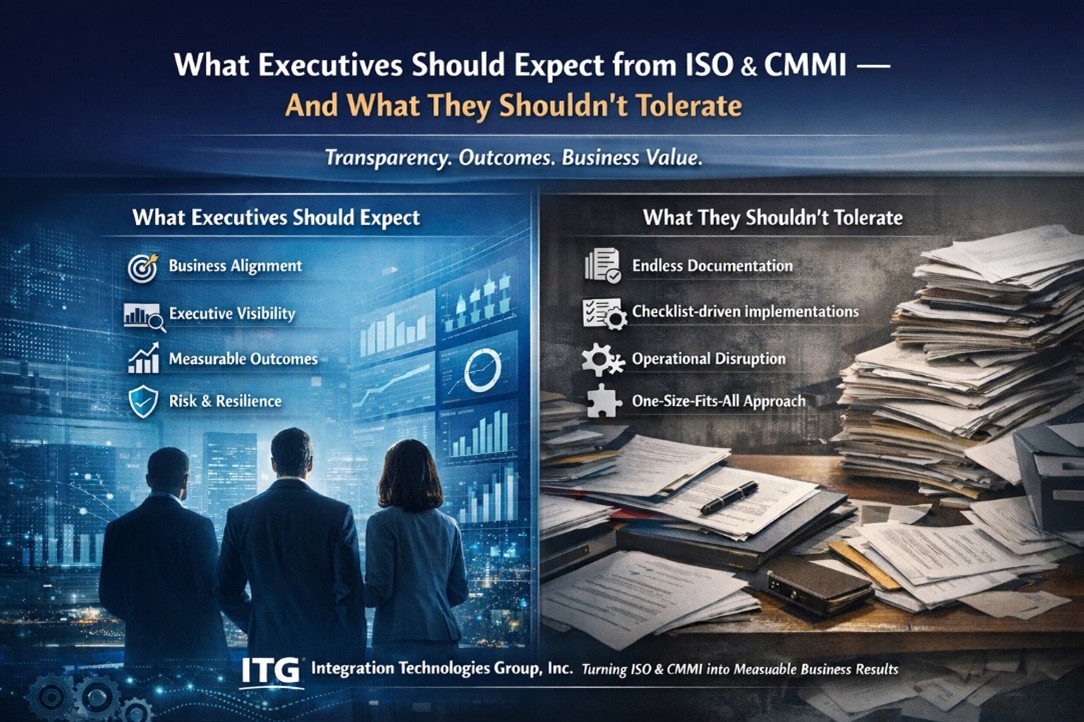
What Leadership Should Expect
Clear Business Alignment
ISO and CMMI initiatives should directly support strategic objectives—whether that is operational efficiency, risk reduction, service reliability, or scalable growth.
- ISO 9001 should improve consistency, decision-making, and customer satisfaction
- ISO 27001 should strengthen risk management and protect business-critical information
- ISO 20000-1 should enhance service performance and accountability
- CMMI should increase predictability, delivery confidence, and organizational maturity
Leadership Transparency
Leadership should never feel disconnected from ISO or CMMI efforts. Effective implementations provide leadership with:
- Meaningful metrics—not audit checklists
- Clear ownership and governance
- Visibility into risk, performance, and improvement
These frameworks should support executive decision-making, not operate in isolation.
Measurable Outcomes Beyond Certification
Certifications and appraisal activities are milestones—not the finish line. Leadership should expect improvements in:
- Operational efficiency and cost control
- Risk awareness and resilience
- Customer confidence and market credibility
- Organizational scalability
What Executives Should Not Tolerate
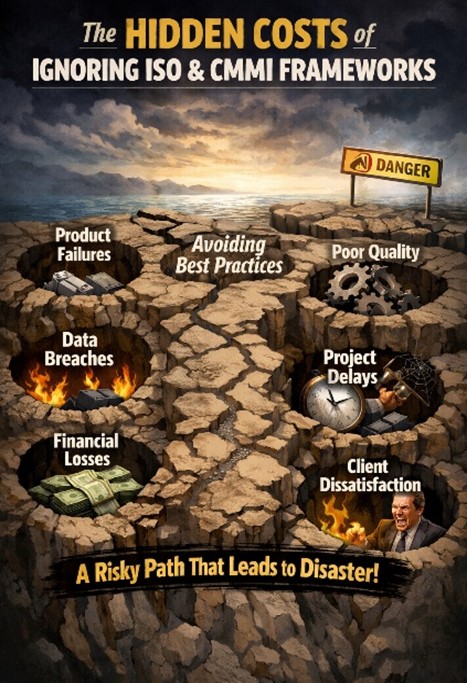
- Frameworks reduced to documentation exercises
- Checklist-driven implementations
- Disruption to operations with little return
- “One-size-fits-all” implementations that ignore culture and strategy
ISO and CMMI should never become administrative burdens or symbolic achievements. When implemented poorly, they erode confidence and waste executive attention.
Advantage of Getting It Right
When ISO 9001, ISO 27001, ISO 20000-1, and CMMI are implemented with intent and discipline, they function as integrated management systems not disconnected compliance initiatives. Executives gain stronger governance, clearer insight, and greater confidence in how the organization operates.
Done right, these frameworks provide leadership with a structured way to manage the business:
- Stronger governance without added bureaucracy
Accountability, decision rights, and escalation paths are clear, enabling leadership to manage risk and performance proactively rather than reactively. - Reduced uncertainty and fewer surprises
Predictable processes, consistent delivery, and disciplined risk management reduce operational volatility and support strategic focus. - Actionable insight for better decisions
Leaders gain visibility into what is working, where improvement is needed, and how investments align with business priorities. - Scalable growth built on discipline
Organizations can expand services, teams, and markets without sacrificing quality, security, or reliability.
The most successful organizations treat ISO and CMMI as business enablers. Tools that strengthen governance, reduce uncertainty, and support sustainable growth and not as compliance obligations to be endured.
Partner with Confidence
Choose Integration Technologies Group, Inc. (“ITG”) to ensure your ISO and CMMI initiatives deliver more than certification providing leadership with clarity, confidence, and measurable results.
We work directly with leadership to ensure frameworks are tailored, pragmatic, and aligned with strategic priorities delivering clarity, control, and value at every stage.