Why Digital Maturity Actually Matters (And What Most Contractors Get Wrong)
Every few years, a new buzzword sweeps through the federal contracting world. “Digital transformation.” “Agile.” “Cloud-first.” Most contractors learn to nod along, maybe update a slide deck, and keep doing what they were already doing.
Digital maturity is different — and if you’re serious about winning federal work over the next decade, it’s worth understanding what it actually means.
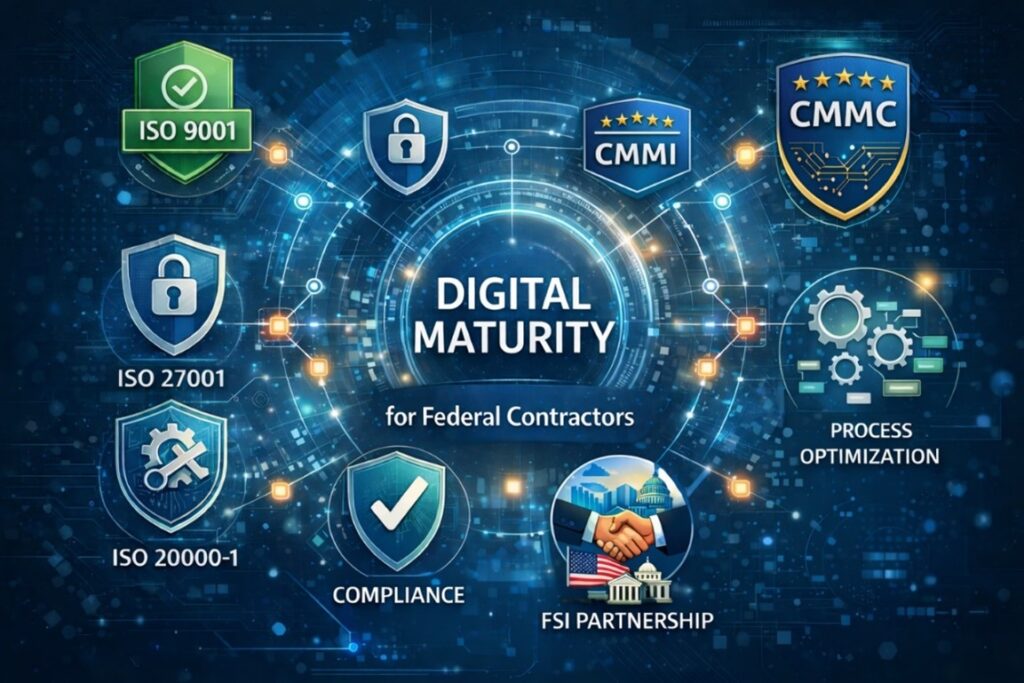
The short version: digital maturity isn’t about having the latest tools. It’s about whether your organization can consistently deliver — at scale, under pressure, and in compliance with increasingly complex federal requirements. Frameworks like ISO and CMMI exist precisely to help you get there. But the how and why tend to get lost in the jargon.
ISO and CMMI: What They Actually Do for You
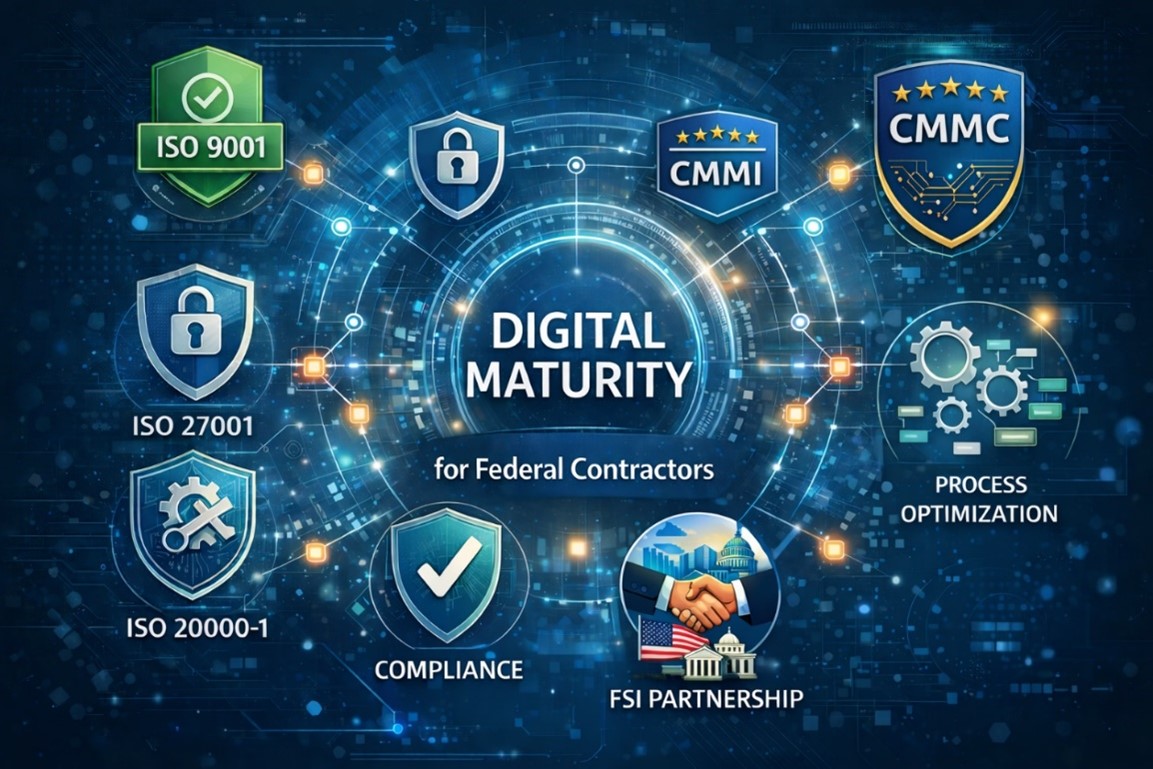
ISO standards — particularly ISO 9001, ISO 27001, and ISO 20000-1 — are about building disciplined, repeatable processes. Think of it less as a certification exercise and more as an honest look at how your organization operates. Are your processes documented? Are they followed? When something goes wrong, do you know why?
For federal contractors, this matters because audit readiness, cybersecurity hygiene, and service delivery consistency aren’t optional extras — they’re baseline expectations. ISO helps you build the infrastructure that makes those things second nature rather than last-minute scrambles.
CMMI addresses something slightly different: organizational maturity in how you manage and execute work. It’s a progression model — the higher your maturity level, the more predictable and optimized your outcomes. For contractors doing software development, IT services, or complex project delivery, that predictability is what separates the teams who reliably hit milestones from the ones always explaining slippage.
Used together, the two frameworks complement each other well: ISO builds quality and security discipline; CMMI builds process maturity and delivery performance. Neither alone is the full picture.
The FSI Factor: Why Your Partners Care About This
Federal Systems Integrators occupy a unique position in the government IT ecosystem. They’re responsible for stitching together complex systems across agencies — often systems that support cybersecurity operations, data management, or critical service delivery. The stakes are high, the oversight is intense, and the tolerance for partners who can’t keep pace is low.
If your growth strategy involves subcontracting with or partnering alongside FSIs, here’s what you need to understand: they are not just looking for technical capability. They’re looking for operational reliability. When an FSI brings you onto a large federal contract, they’re staking some of their own reputation on your performance. That’s why they gravitate toward partners who have ISO or CMMI credentials — not because of the certificates themselves, but because of what those credentials signal.
They signal that you:
- Have documented, auditable processes — not just good intentions
- Understand how to manage risk before it becomes a problem
- Can scale delivery without sacrificing quality
- Are built for long-term collaboration, not just a single task order
FSIs leading their own digital transformation — deploying cloud infrastructure, integrating AI, automating legacy processes — need partners who can move at that pace. Digital maturity is what makes you one of them.
The Competitive Reality for Federal Contractors
Federal procurement has grown considerably more sophisticated. Contracting officers and program managers aren’t just evaluating technical proposals — they’re asking whether a contractor has the organizational depth to perform consistently over a multi-year period. Regulations like CMMC and DFARS 252.204-7021 have made cybersecurity maturity a hard requirement, not a differentiator.
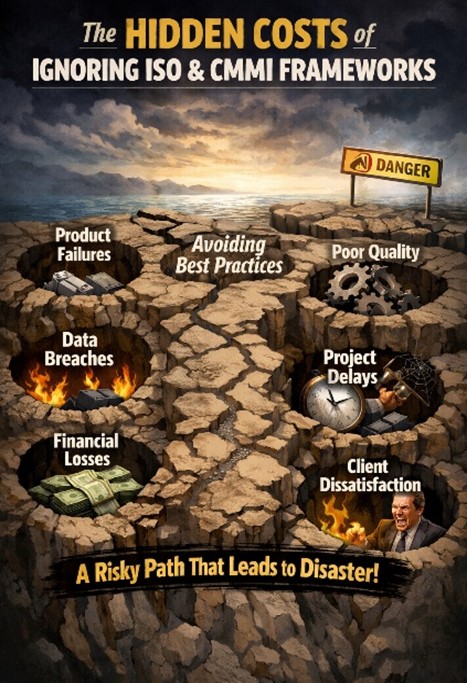
What that means practically: if your competitors have invested in ISO and CMMI and you haven’t, you’re already behind — not just in the bidding process, but in your actual ability to perform on complex contracts. Mature processes aren’t overhead. They’re what prevent cost overruns, audit findings, and delivery failures.
Common Misconceptions Worth Addressing
“This is just a technology problem.”
It’s not. The organizations that struggle most with digital maturity usually have decent technology — they just haven’t built the processes and culture to use it effectively. Buying a new platform doesn’t fix a broken workflow. ISO and CMMI force the harder conversation: are your people and processes actually ready to support the tools you’re deploying?
“We’ll slow down if we implement these frameworks.”
In the short term, yes — there’s real investment involved. But contractors who’ve been through the process consistently report the opposite outcome once things are in place. Standardized processes reduce rework, shorten decision cycles, and make onboarding new team members faster. The friction you feel upfront is mostly the friction of fixing things that were already broken.
“We got certified — we’re done.”
Certification is a milestone, not a finish line. Both ISO and CMMI are built around continuous improvement — meaning the expectation is that you keep reassessing, keep updating, and keep raising the bar. Organizations that treat certification as a one-time box-check tend to find their processes drifting back toward old habits within a year or two.
“We only need one of the two frameworks.”
Some contractors try to pick one and skip the other. It’s understandable — both frameworks require real investment. But ISO and CMMI address different dimensions of maturity, and the gaps left by implementing only one tend to show up at inconvenient moments. If you’re serious about competing at the FSI level or on large agency contracts, both are worth the commitment.
How ITG Can Help
At Integration Technologies Group (ITG), we work with federal contractors who are serious about building the kind of organizational maturity that opens doors — to larger contracts, to FSI partnerships, and to sustained performance over time.
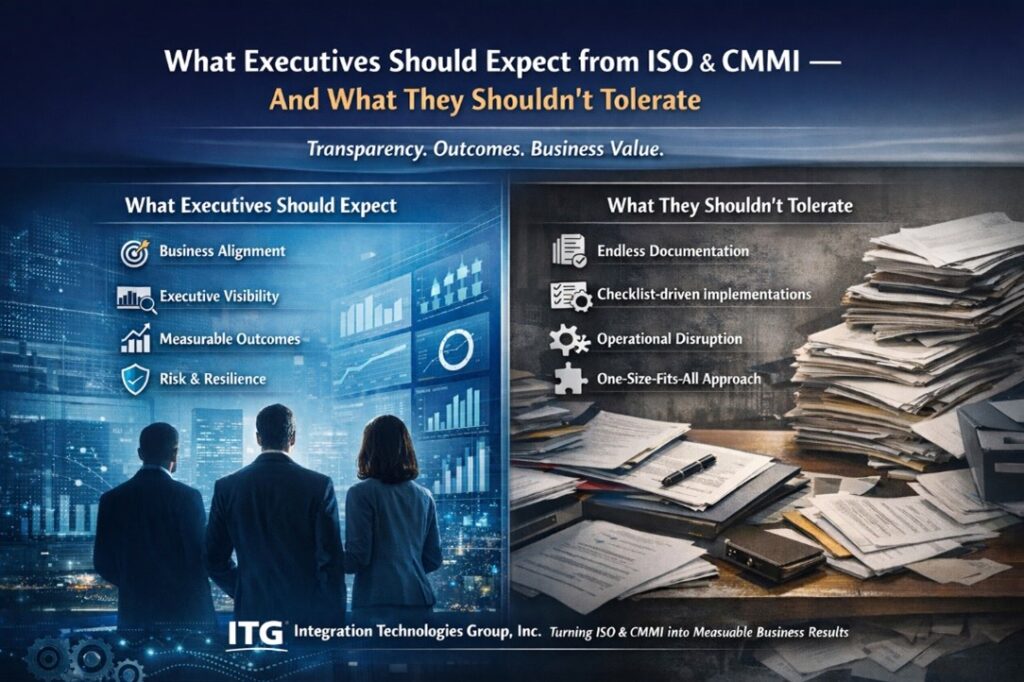
We don’t just hand you a compliance checklist. We help you understand what these frameworks actually mean for your organization, where your real gaps are, and how to close them in a way that sticks. That includes initial readiness assessments, process redesign, cybersecurity maturity work, and the ongoing support that keeps you from backsliding after certification.
Our services include:
- Compliance Readiness Assessments and Audits
- Process Optimization and Automation
- Cybersecurity Maturity and Risk Management
- Ongoing Support and Continuous Improvement
If you’re ready to have an honest conversation about where your organization stands and what it would take to get where you want to go, we’d like to talk.